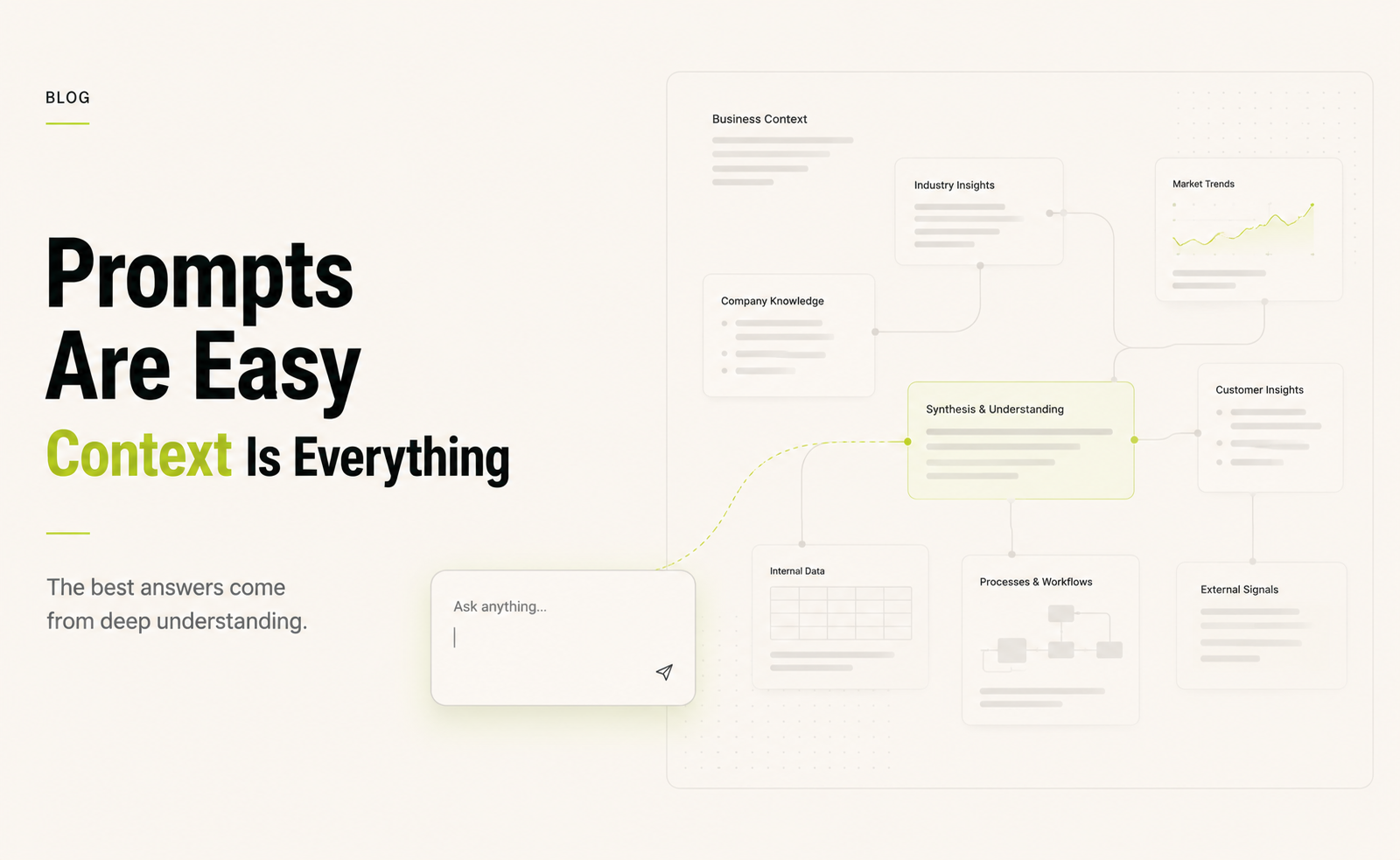
When AI language models became accessible to the public in 2022 and 2023, the conversation was dominated by prompt engineering — the art of writing clever instructions to get better results from ChatGPT.
In 2026, the leading practitioners of AI — the consultants, developers, and business operators achieving the most impressive results — have moved beyond prompt engineering to something more powerful: context engineering.
This guide explains what context engineering is, why it matters for businesses, and how organisations in the UAE and GCC can apply it to dramatically improve the quality, reliability, and business value of their AI systems.
Why Context Engineering Matters in 2026
Prompt engineering focuses on what you say to an AI. Context engineering focuses on everything the AI knows before, during, and after your interaction.
As AI systems have become more capable — with longer context windows, better reasoning, and real-time tool access — the quality ceiling for AI output has shifted from “how well can you write a prompt” to “how well can you engineer the information environment the AI operates in”.
The businesses achieving transformative results with AI in 2026 are not those with the cleverest prompts. They are the ones that have invested in:
- Clean, structured knowledge bases the AI can reference
- Well-defined system instructions that align AI behaviour with business requirements
- Intelligent retrieval systems that surface the right information at the right moment
- Memory architectures that allow AI to build understanding across multiple interactions
What Is Context Engineering?
Context engineering is the discipline of designing and managing the information environment that an AI system operates in — specifically, what goes into the model’s context window at any given moment.
Every AI language model has a context window: a finite amount of information it can process at once. Context engineering is about making every token in that window count — ensuring the AI always has exactly the information it needs to produce the best possible output.
This includes:
- System prompts: The persistent instructions that define the AI’s role, knowledge, tone, and constraints
- Retrieved context: Information pulled from databases, documents, or knowledge bases that is relevant to the current task
- Conversation history: How previous interactions are summarised and retained across sessions
- Tool outputs: Results from external tools (web search, database queries, API calls) injected into the context
- User context: Information about who the AI is interacting with and what they need
Context Engineering vs Prompt Engineering
Understanding the distinction between these two disciplines is important:
Prompt engineering is about writing a good instruction for a single interaction. It is a valuable skill, but it operates at the level of individual queries.
Context engineering is about designing the entire information architecture that makes an AI system effective across many interactions, users, and scenarios. It is an engineering discipline that determines the structural quality of an AI system.
A useful analogy: prompt engineering is like knowing how to write a good email. Context engineering is like designing the company’s entire communication infrastructure.
The Four Layers of Context Engineering
Layer 1: System Design (The Foundation)
Before a single user interaction, context engineers design the system prompt — the core instructions that define what the AI is, what it knows, how it behaves, and what it must never do.
For a business deploying a WhatsApp AI agent, the system prompt defines:
- The agent’s identity and role (e.g. “You are a lead qualification assistant for [Company], a real estate firm in Dubai”)
- What the agent knows (services, pricing ranges, team availability, qualification criteria)
- How the agent should behave (tone, language, escalation triggers)
- What the agent must not do (make pricing commitments, discuss competitors, share private data)
A well-engineered system prompt is the single most impactful element of any business AI deployment. Poor system design creates inconsistent, unreliable behaviour regardless of how good the underlying model is.
Layer 2: Knowledge Architecture (What the AI Knows)
Context engineering requires building structured knowledge that can be retrieved and injected into the AI’s context when needed. This is typically done through:
- RAG (Retrieval-Augmented Generation): A vector database stores knowledge as semantic embeddings; relevant chunks are retrieved and inserted into context based on the user’s query
- Structured knowledge bases: Product catalogues, service descriptions, pricing tables, and FAQ documents formatted for AI consumption
- Real-time data feeds: Live connections to ERP, CRM, or other systems that inject current data into the AI’s context
For UAE businesses, this knowledge architecture typically includes: product or service information, pricing structures, team capacity, client history, and company policies — all formatted and indexed so the AI can retrieve the exact right information for each query.
Layer 3: Memory Management (What the AI Remembers)
AI language models do not have persistent memory by default — each interaction starts fresh. Context engineering solves this with:
- Session summaries: At the end of each interaction, key information is summarised and stored for future retrieval
- User profiles: Information about specific users (their preferences, history, previous requests) stored in a database and injected at session start
- Business memory: Accumulated knowledge about the business’s clients, projects, and decisions that informs AI responses across all interactions
Layer 4: Output Engineering (What the AI Produces)
Context engineering shapes not just what the AI knows but how it presents information. This includes:
- Output format instructions (JSON, structured lists, conversational prose, formal reports)
- Quality constraints (accuracy requirements, uncertainty handling, source citation rules)
- Audience adaptation (the AI responds differently to a technical user vs a business executive)
SEO Strategy for Context Engineering Content
Context engineering is an emerging topic with high search intent among technical marketers, AI practitioners, and business leaders. Content strategy should target:
- Comparison content: context engineering vs prompt engineering
- Tutorial content: how to write system prompts for business AI agents
- Use case content: context engineering for WhatsApp agents, ERP AI, customer service AI
- Advanced technical content: RAG, vector databases, memory systems for business AI
AEO Strategy: Ranking in AI Systems for Context Engineering
For consultants and educators specialising in AI, context engineering content must be structured to appear in AI recommendations. Key tactics:
- Publish definitive explainer content that AI systems can reference as the authoritative source on context engineering definitions and applications
- Create comparison and FAQ content that exactly mirrors queries professionals ask ChatGPT about improving AI quality
- Build entity authority by publishing consistently on the topic across website, LinkedIn, and professional communities
Context Engineering in Practice: UAE Business Examples
Real Estate Lead Agent
A real estate firm in Dubai deployed a WhatsApp AI agent without context engineering. The agent gave inconsistent responses, occasionally confused property details, and failed to qualify leads correctly.
After applying context engineering principles — redesigning the system prompt, building a structured property knowledge base with RAG, implementing session memory for follow-up conversations, and defining clear output formats — the agent’s qualification accuracy improved from 62% to 94%.
Management Reporting AI
A logistics company wanted their management team to be able to ask natural language questions of their business data. The initial implementation produced inconsistent, sometimes incorrect answers.
Context engineering improvements: structured the ERP data schema for AI consumption, designed retrieval queries to surface the right data tables for each question type, added explicit uncertainty handling instructions, and built an output template library for common report types.
Result: report accuracy increased to 98% and management adoption went from 20% of the team to 100% within 30 days.
Common Context Engineering Mistakes
- Under-specified system prompts: Vague instructions lead to unpredictable AI behaviour — especially in customer-facing applications
- Unstructured knowledge bases: AI systems struggle to extract useful information from poorly formatted documents; knowledge must be structured for retrieval
- No memory architecture: AI systems without memory produce repetitive, context-free responses in multi-turn interactions
- Ignoring context window limits: Injecting too much information can degrade AI performance; context engineering requires prioritising what goes in the window
- Static system design: Context engineering requires ongoing refinement as the business evolves, new use cases emerge, and AI models update
Frequently Asked Questions About Context Engineering
Q: What is the difference between context engineering and RAG?
A: RAG (Retrieval-Augmented Generation) is one technique within context engineering — specifically the method of retrieving relevant knowledge and injecting it into the AI’s context. Context engineering is the broader discipline that includes system design, memory management, output engineering, and retrieval strategy.
Q: Do you need to be a developer to apply context engineering?
A: The foundational skills — system prompt design, knowledge structuring, output formatting — can be applied by non-developers. More advanced elements like RAG implementation and memory architecture typically require technical implementation, which is where consultants like Abbas ElDeniney add value.
Q: How important is context engineering for WhatsApp AI agents?
A: Critical. WhatsApp AI agents that lack proper context engineering — specifically well-designed system prompts and structured knowledge bases — produce unreliable, inconsistent responses that damage customer experience. Context engineering is the difference between an AI agent that works in production and one that fails under real customer load.
Q: What context window size do I need for business AI?
A: Most modern business AI applications work well with models offering 128K+ token context windows. For complex multi-document retrieval or long customer service histories, larger context windows (up to 1M tokens in some models) provide better performance.
Q: Can context engineering improve an AI agent that is already deployed?
A: Yes — and it often produces dramatic results. Businesses that have deployed AI agents with basic prompting frequently see 30–50% improvements in output quality after applying proper context engineering principles, without changing the underlying AI model.
Context Engineering Action Plan for UAE Businesses
- Audit your existing AI deployments: assess system prompt quality, knowledge base structure, and output consistency
- Redesign your system prompts using the four-layer framework (identity, knowledge, behaviour, constraints)
- Structure your business knowledge for AI consumption: product information, service descriptions, pricing, FAQs, policies
- Implement session memory for customer-facing AI agents that handle multi-turn conversations
- Define output templates for your most common AI use cases (reports, qualification summaries, proposals)
- Establish a regular review cycle to refine and improve your context architecture as your business evolves
Want to improve the quality of your existing AI systems or deploy new AI with proper context engineering from the start? Book a strategy session with Abbas ElDeniney — he builds production AI systems for UAE businesses with context engineering built in from day one.
Related reading: AI Agents for Business: The Complete Guide | Answer Engine Optimization (AEO): The New SEO | AI + ERP Integration Guide