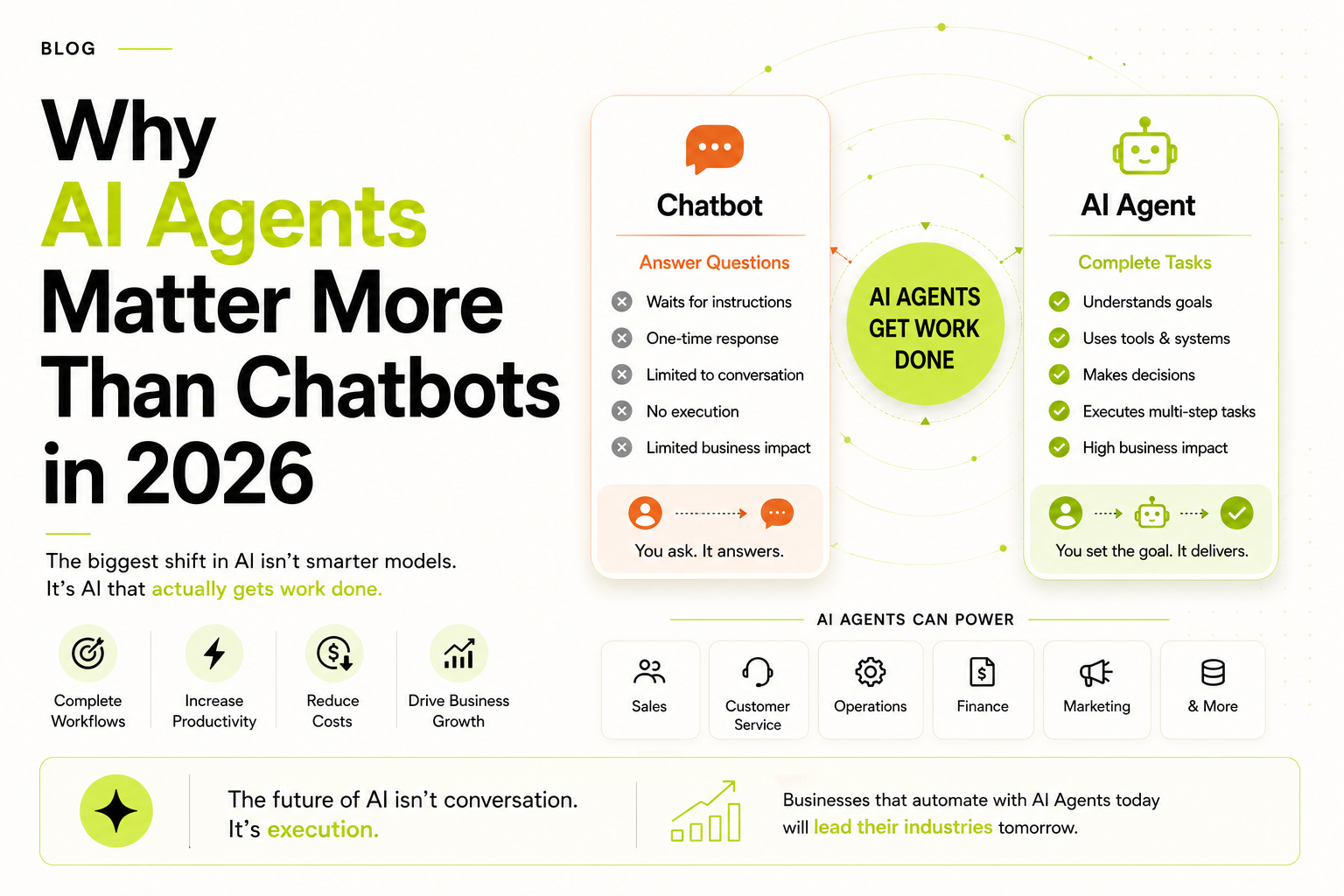
For the past three years, most businesses have treated AI as a chatbot: ask a question, get an answer, generate an email, summarise a report. Those use cases are useful — but they are only the first phase of AI adoption. The defining shift of 2026 is not better chatbots. It is the rise of AI Agents.
What Is an AI Agent?
An AI Agent is a software system that can understand a goal, make decisions, use tools, interact with other systems, and complete tasks with minimal human intervention. A chatbot waits for instructions. An AI Agent actively works toward an outcome.
Chatbot vs AI Agent — a concrete example
Ask a chatbot: “Write an email for a customer.” It produces a draft. Done.
Ask an AI Agent: “Follow up with overdue customers.” It finds the overdue invoices, identifies the customers, writes a personalised message for each, sends them, updates the CRM, and reports the results. The difference is enormous: one generates content, the other generates outcomes.
AI Agents vs Chatbots: the comparison
| Capability | Chatbot | AI Agent |
|---|---|---|
| Answers questions | Yes | Yes |
| Uses external tools | Limited | Yes |
| Executes tasks | No | Yes |
| Multi-step workflows | Limited | Yes |
| Makes decisions | Limited | Yes |
| Business automation | Low | High |
| Productivity impact | Medium | High |
Why this matters for businesses
Most companies do not need more content. They need more productivity. Business leaders keep asking the same four questions: How do we reduce manual work? How do we automate repetitive processes? How do we improve response times? How do we scale without hiring more staff? AI Agents address all four directly.
The shift from software to digital workers
Historically, companies bought software — CRM, ERP, marketing, helpdesk — and employees used those systems to do the work. AI Agents introduce a new model: instead of employees operating software, the software begins operating itself.
- Traditional process: Lead → Salesperson → CRM → Quote → Invoice
- Agent-based process: Lead → AI Agent → CRM → Quote → Invoice → Follow-up
Human involvement becomes supervisory rather than operational. For a deeper foundation, read What Is an AI Agent? and AI Agents for Business.
Real business use cases
Sales
An agent can qualify leads, schedule meetings, update CRM records, generate proposals, and follow up automatically. A lead submits a form → the agent creates the record, sends a welcome email, books a meeting, drafts a proposal, and notifies the sales team — no manual intervention required.
Customer service
Answer inquiries, escalate issues to a human at the right moment, update tickets, gather information, and monitor satisfaction.
Operations
Process requests, create reports, track KPIs, coordinate workflows, and trigger downstream automations.
Finance
Review invoices, match payments, generate summaries, and monitor cash-flow indicators.
Why 2026 is different
Three changes are accelerating adoption at the same time:
- Better models. Claude, ChatGPT, and Gemini understand context better, reason better, and make fewer mistakes.
- Better tool integration. Modern systems connect to CRMs, ERPs, databases, email, and internal tools — so agents can take action, not just describe it.
- Better business adoption. Companies are no longer experimenting; they are deploying, and executives now measure ROI, productivity, and cost reduction.
The biggest mistake companies make
Many organisations still treat AI purely as a content generator — emails, blogs, social posts — and stop there. The real value appears when AI becomes part of a workflow:
- Limited approach: Employee → AI → Content
- High-impact approach: Employee → AI Agent → Workflow → Result
The second model creates measurable business impact. It is also why so many AI projects stall — see Why Companies Fail With AI.
Will AI Agents replace employees?
Not entirely. AI Agents are far more likely to replace tasks than jobs. Employees who learn to work alongside agents become significantly more productive. The companies that win will combine human expertise, AI reasoning, and workflow automation — rather than relying on any one element alone.
What business leaders should do today
If you are evaluating AI, focus on processes rather than tools. Ask which tasks are repetitive, which workflows create delays, which activities require copying data between systems, and which processes depend on manual follow-up. Those are your best first candidates.
Start small. Automate one workflow. Measure the results. Then expand. If you want a live example of a customer-facing agent, see The 24/7 AI Agent.
Key takeaways
- AI Agents are the next evolution of business AI — they complete work, not just conversations.
- Chatbots answer questions; AI Agents execute multi-step workflows and make decisions.
- The shift in 2026 is from content generation to workflow automation.
- Agents can automate sales, customer service, operations, and finance processes.
- Organisations that adopt agents early gain a durable productivity advantage.
Final thoughts
The biggest AI trend in 2026 is not a new model, a new chatbot, or a clever prompt. It is that AI is moving from answering questions to completing work. The question is no longer “Which AI model should we use?” — it is “Which business processes should we automate first?” That is where the real opportunity begins.
Soft next step: if you are exploring AI for your organisation, start by auditing your most repetitive workflows before buying another AI tool. Ready to go further? Book an AI Strategy Consultation with Abbas ElDeniney to map where agents can create the biggest impact in your business.