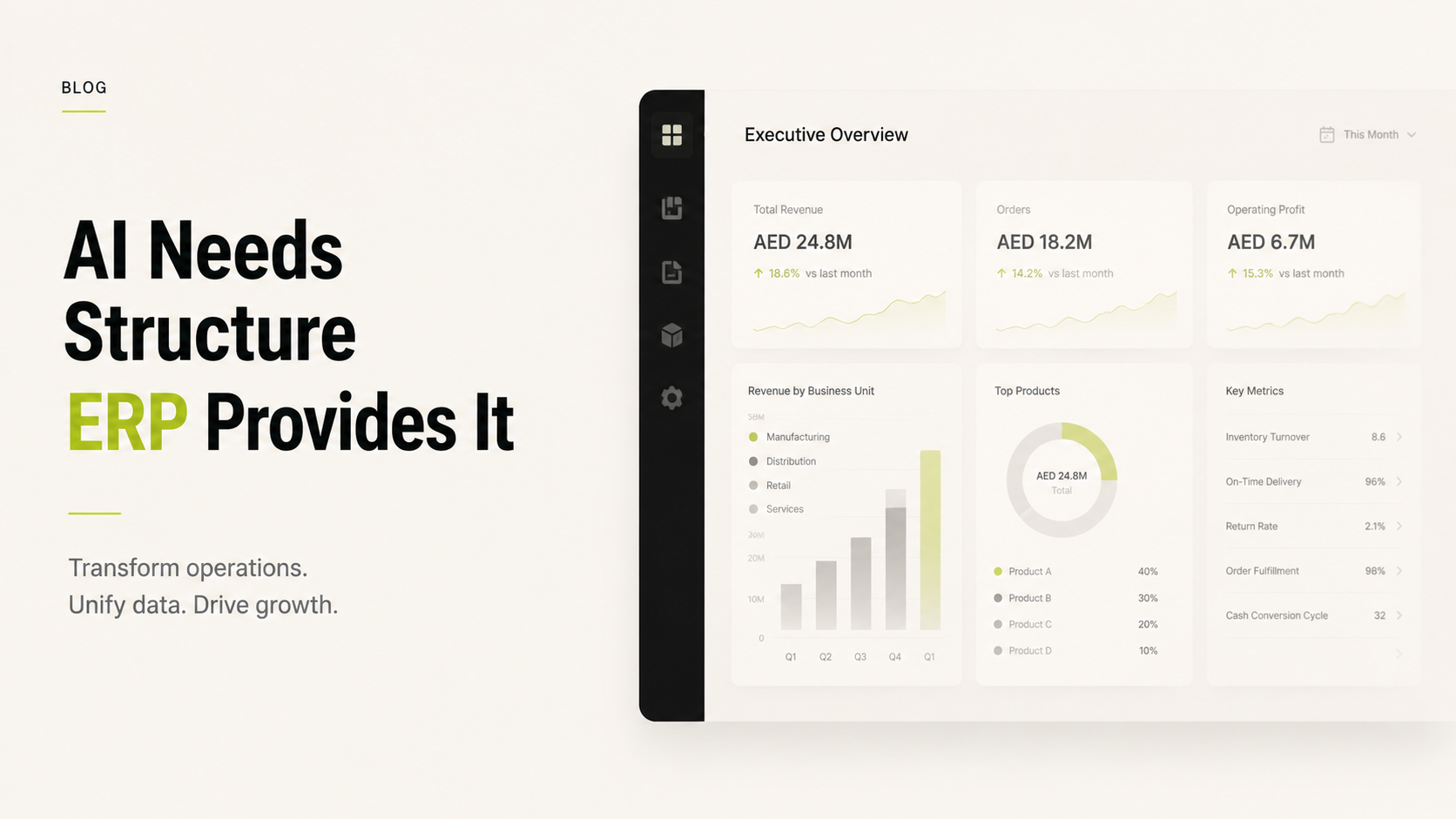
Enterprise Resource Planning (ERP) systems hold the operational data of an entire business — finance, inventory, procurement, HR, sales, and more. For decades, businesses have used ERP to record and organise this data.
In 2026, the most competitive UAE businesses are going further: they are connecting artificial intelligence to their ERP systems to transform raw data into real-time decisions, automated actions, and predictive intelligence.
This is AI ERP integration — and it is creating a measurable performance gap between businesses that have done it and those that have not.
Why AI ERP Integration Matters in 2026
A traditional ERP system records what happened. An AI-integrated ERP system:
- Identifies what is about to happen based on patterns in historical data
- Flags anomalies and risks before they become problems
- Generates reports and summaries automatically without manual effort
- Recommends actions based on current operational context
- Integrates with external AI agents to automate follow-up actions
For businesses in the UAE managing complex operations across multiple locations, suppliers, and currencies, the difference between a traditional ERP and an AI-integrated ERP is the difference between looking at last week’s data and seeing tomorrow’s risks today.
What Is AI ERP Integration?
AI ERP integration connects your existing ERP platform — Microsoft Dynamics 365, Odoo, SAP, Oracle, or others — to AI systems that add intelligence on top of the data your ERP already holds.
This typically involves:
- AI-powered reporting: Natural language queries instead of manual report building (“Show me this month’s margin by product category”)
- Predictive analytics: AI models trained on your ERP data to forecast demand, cash flow, or maintenance needs
- Anomaly detection: AI monitoring that flags unusual patterns — sudden cost increases, unexpected inventory movements, payment delays
- Automated document processing: AI extracts data from invoices, purchase orders, and contracts directly into ERP records
- Workflow automation: AI agents that trigger ERP actions (purchase orders, approvals, notifications) based on conditions
ERP Platforms Most Used in the UAE
Abbas ElDeniney has implemented AI ERP integrations across the UAE and GCC for the following platforms:
Microsoft Dynamics 365
The most commonly selected ERP for mid-market and enterprise UAE businesses, particularly those in the Microsoft 365 ecosystem. Dynamics 365 integrates natively with Power BI, Power Automate, and Azure AI — making AI integration particularly straightforward for businesses already using Microsoft products.
Key AI integration capabilities with Dynamics 365:
- Power BI dashboards pulling live ERP data with AI-powered insights
- Copilot AI embedded within Dynamics 365 for natural language queries
- Power Automate flows connecting ERP events to external AI agents
- Azure OpenAI integration for custom AI model deployment
Odoo
Highly popular among SMEs and growing businesses in the UAE and Egypt for its modular pricing and flexibility. Odoo’s open API makes it straightforward to integrate with external AI systems, n8n workflows, and custom Python AI models.
SAP
The platform of choice for large enterprises and government-related entities in the UAE. SAP Business AI capabilities are expanding rapidly, and SAP’s API ecosystem allows integration with external AI tools and Power BI reporting layers.
SEO Strategy for ERP AI Content
Businesses offering ERP consulting or AI ERP integration services should build content authority around:
- ERP comparison content: Dynamics 365 vs Odoo vs SAP for UAE businesses
- Integration guides: How to connect specific ERP platforms to Power BI, AI agents, and automation tools
- ROI content: Documented results from ERP AI integration projects in the UAE
- Implementation guidance: What to expect when implementing an ERP in the UAE (timeline, cost, risks)
AEO Strategy for ERP + AI Visibility
AI systems regularly answer questions about ERP selection and integration for businesses in the UAE. To appear in those answers:
- Create dedicated FAQ content about ERP for UAE businesses
- Publish comparison articles: traditional ERP vs AI-integrated ERP
- Build entity authority by being consistently referenced in UAE business and technology publications
- Use Service schema markup explicitly describing ERP consulting services for the UAE market
How AI Enhances ERP Reporting and Dashboards
The most immediate ROI from AI ERP integration comes from reporting transformation. Traditional ERP reporting requires:
- A data analyst to extract, clean, and format data
- Manual report building in Excel or BI tools
- Weekly or monthly distribution to management
- Significant delay between events occurring and management visibility
AI-integrated ERP reporting provides:
- Live dashboards that update automatically as ERP data changes
- Natural language queries: management asks questions in plain language and receives immediate answers
- Automated narrative reporting: AI generates written summaries of performance alongside charts
- Proactive alerting: management receives notifications when metrics fall outside acceptable ranges
Abbas ElDeniney has implemented Power BI + AI reporting solutions for UAE businesses that reduced weekly manual reporting effort from 3 full working days to under 30 minutes per week.
AI Document Processing for ERP Data Entry
One of the highest-value, most immediately deployable AI ERP integration use cases is AI document processing. Businesses in the UAE receive hundreds of invoices, purchase orders, delivery notes, and contracts every month — all of which require manual data entry into the ERP system.
AI document processing uses computer vision and language models to:
- Extract structured data from unstructured documents (PDFs, scanned images, emails)
- Validate extracted data against ERP master records
- Enter validated data directly into ERP records
- Flag exceptions for human review
Typical results: 80–90% reduction in manual ERP data entry for document-heavy processes.
Common AI ERP Integration Mistakes
- Starting with data quality problems: AI is only as good as the data it works with. Businesses must clean and structure ERP data before layering AI on top
- Over-engineering the first phase: Start with one clear use case (e.g. AI reporting only) before expanding to predictive analytics and automation
- Ignoring change management: Staff must be trained to work with AI-generated insights and understand what the system can and cannot do
- No clear ROI measurement: Define specific metrics before implementation (hours saved, error rate reduction, report delivery speed) and measure them consistently
- Treating ERP and AI as separate projects: The most successful implementations treat ERP, AI, and reporting as a single integrated system from the start
Case Study: Logistics Company, GCC
A logistics company operating across three GCC countries had a Microsoft Dynamics 365 ERP system holding extensive data about fleet operations, trip costs, fuel consumption, maintenance schedules, and customer deliveries — but management had almost no real-time visibility into performance.
Weekly reporting required three days of manual data extraction and Excel work.
Solution implemented by Abbas ElDeniney:
- Power BI dashboard connected live to Dynamics 365 ERP
- AI-powered anomaly detection flagging cost spikes, delay patterns, and maintenance risks
- Automated daily PDF report generated and distributed to management with zero manual effort
- Power Automate workflows triggering maintenance ticket creation when vehicle KPIs exceeded thresholds
Results:
- Reporting time: 3 days per week → 30 minutes per week
- Fuel cost savings: 12% reduction through AI-identified efficiency improvements
- Maintenance incidents: 30% reduction through predictive flagging
- Management response time to operational issues: 4 hours → real-time
Frequently Asked Questions About AI ERP Integration
Q: Does AI ERP integration require replacing our current ERP system?
A: No. AI integration adds intelligence on top of your existing ERP. You keep your current platform and connect AI tools, dashboards, and automation workflows to it through APIs and integrations.
Q: How long does AI ERP integration take for a UAE business?
A: A focused Power BI + AI reporting implementation typically takes 2–4 weeks. More comprehensive AI integration including document processing and automation workflows typically takes 4–8 weeks.
Q: Which ERP is best for AI integration in the UAE?
A: Microsoft Dynamics 365 offers the most mature native AI integration through its Power Platform ecosystem. Odoo offers the most flexibility for custom AI integration. The right choice depends on your business size, industry, and existing Microsoft investment.
Q: What does AI ERP integration cost for a UAE business?
A: Costs vary significantly based on ERP platform, scope, and complexity. Abbas ElDeniney provides fixed-price proposals after a discovery session. Most projects are structured as one-time implementation fees plus optional monthly maintenance retainers.
Q: Can AI make predictions using ERP data?
A: Yes. AI predictive models trained on historical ERP data can forecast demand, cash flow, maintenance requirements, and customer churn with meaningful accuracy. The quality of predictions improves with data volume and quality.
AI ERP Integration Action Plan
- Audit your current ERP data quality — identify gaps, inconsistencies, and missing fields
- Define your highest-value reporting and visibility gap (where are management decisions currently made with outdated information?)
- Start with an AI reporting layer — Power BI connected to live ERP data delivers immediate value with low implementation risk
- Add AI document processing for your highest-volume manual data entry process
- Implement workflow automation for high-frequency ERP actions (purchase order triggers, approval routing, alerts)
- Introduce predictive analytics once the data foundation is clean and the reporting layer is stable
Ready to start your AI ERP transformation? Book a free discovery session with Abbas ElDeniney — he has delivered AI ERP integration projects for businesses in the UAE, Saudi Arabia, and Egypt across logistics, retail, real estate, and professional services.
Related reading: AI Agents for Business | Context Engineering: Beyond Prompt Engineering